
Transition Detection in Flow Boundary Layers
Imagine being able to identify the laminar-turbulent transition on any streamlined profile. In the air and in the water. Continuously and in realtime.

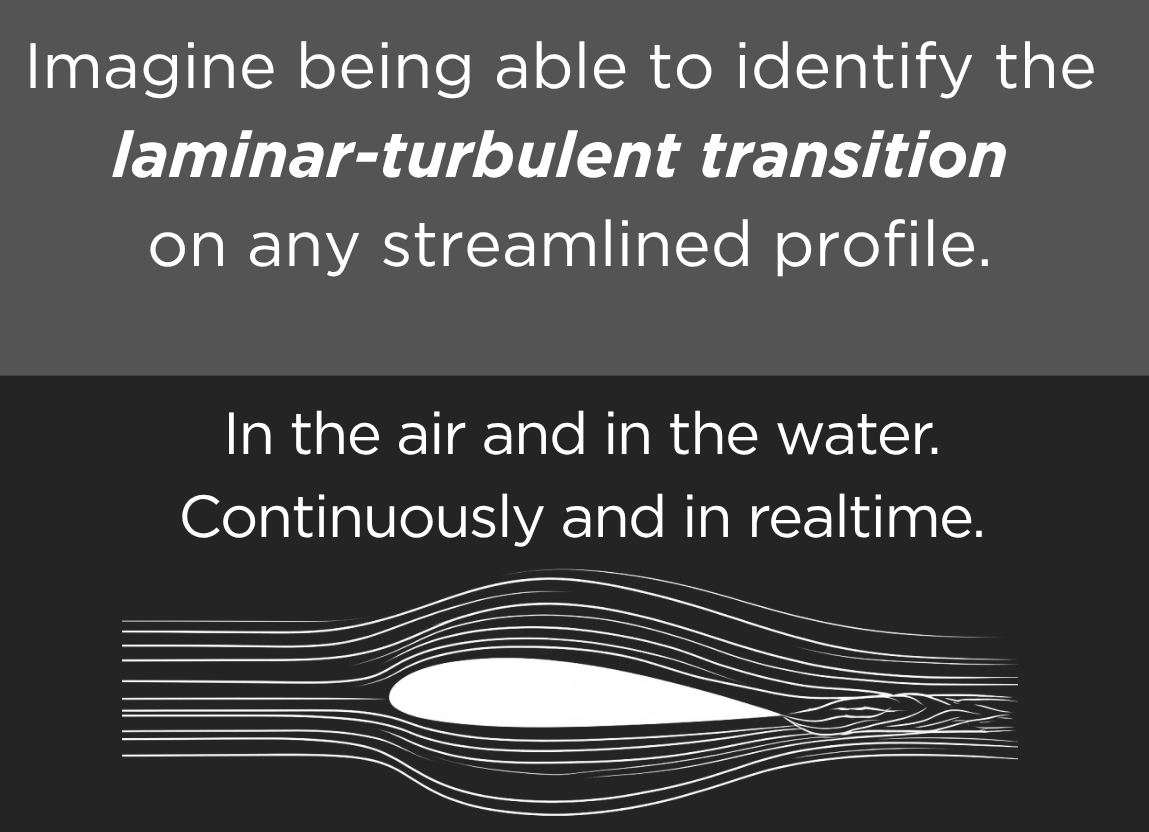
Transition detection and localization is becoming increasingly important in both aviation and maritime technology because it is critical for performance, safety, and sustainability.
By detecting and controlling the transition from laminar to turbulent flow, aircraft can be designed to remain in the laminar state longer. This saves fuel (up to 10–15% in modern aircraft) and reduces CO₂ emissions.
For ships and other watercraft, an optimized boundary layer reduces water resistance, leading to lower energy consumption and longer ranges.
Why Measurements are Essential for Validating CFD Models
Numerical flow simulations (CFD) have become a central tool in fluid-mechanical design. Nevertheless, their predictive power fundamentally depends on the quality of the underlying models. Transition in particular – the change from laminar to turbulent flow – is characterized by unstable, three-dimensional, and multi-scale phenomena that can only be approximated analytically. Turbulence and transition models rely on simplifications and empirical coefficients whose transferability to new geometries, Reynolds numbers, and pressure gradients must be demonstrated in each case. High-resolution simulations (DNS/LES) are inherently more accurate but computationally prohibitive for industrial applications. Experimental data therefore serve as the benchmark against which CFD models are calibrated, verified, and validated – they form the basis for reliability, certification, and ultimately for design decisions in the real product.
Reliable Measurement Technology for Tests in Facilities and in the Field
We offer measurement technology that detects and localizes transition processes continuously and in real time – both under controlled laboratory conditions in wind and water tunnels and in real-world outdoor environments, for example on prototypes, in flight, or at sea. In this way, we close the gap between purely numerical prediction and real flow physics, providing the data foundation to validate transition models under realistic conditions.
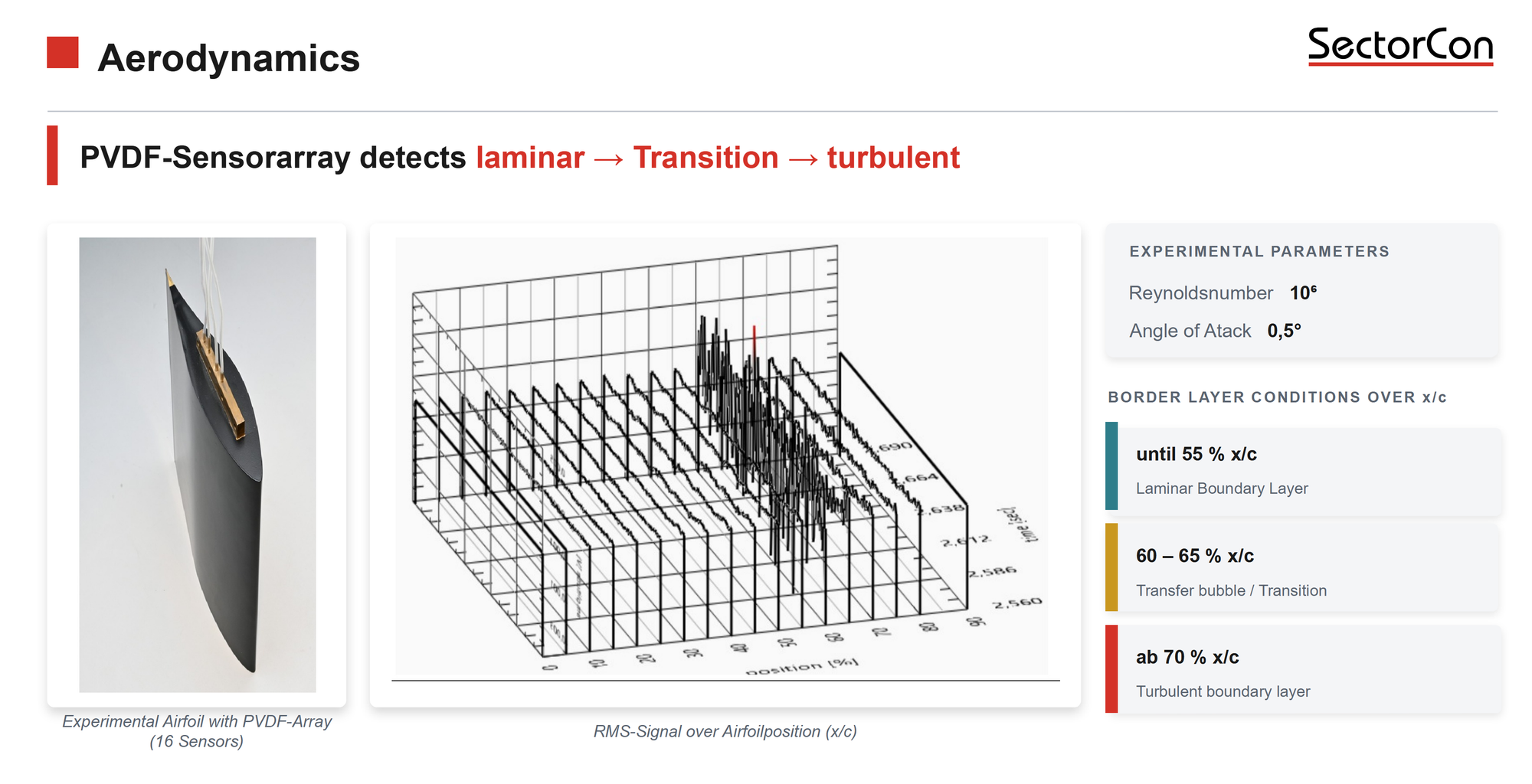
Advantages of this Measurement Technology
- Higher resolution and accuracy: The transition line is detected with spatial resolution, rather than merely estimated globally as with conventional methods.
- Validated CFD pipelines: Models are benchmarked against robust measurement data – resulting in more reliable simulations and shorter development cycles.
- Scalability: One and the same measurement technology works in the tunnel and in the field, so results from laboratory tests can be directly transferred to real-world applications.
- Resource efficiency: Fewer test requirements thanks to more targeted test planning – measurement and simulation complement each other optimally.
- Cost-effectiveness and sustainability: Longer laminar run lengths mean less drag, lower fuel and energy consumption, and thus reduced CO₂ emissions – the measurement technology makes this effect measurable and controllable.
- Safety: Early and precise detection of flow transition reduces the risk of unforeseen aerodynamic or hydrodynamic loads.
If you are interested in our advanced technologies,
please contact via e-mail to detect@sector.de.